The one Fujifilm GF lens I'd take anywhere for landscapes
After years of shooting landscapes on the GFX system, one Fujifilm GF lens stays on my camera more than any other. It's not the widest, the longest, or the most exotic option in the lineup. Here's the lens I reach for most, and the reasons I keep coming back to it.

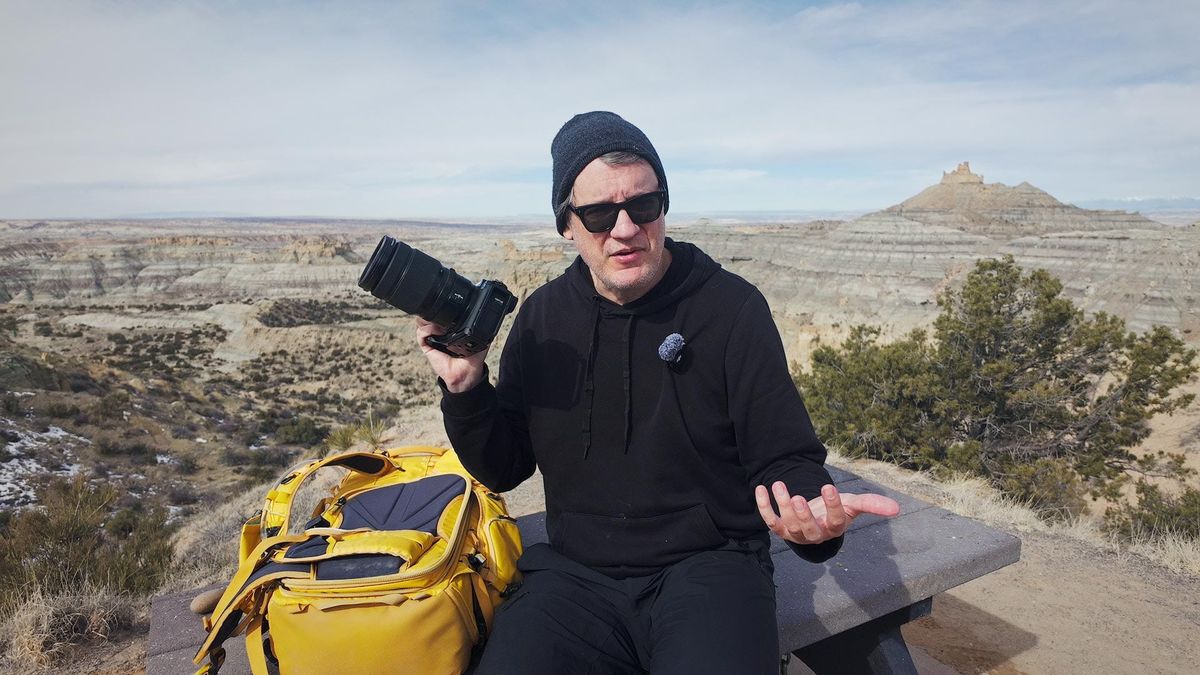
Fujifilm offers many excellent prime and variable zoom GF lenses. Fewer third party manufacturers make GF mount compatible lenses, but Fujifilm's official lenses are generally excellent quality and reasonably priced, especially when on sale (typically around Black Friday each year). I've tried a number of GF lenses for creating landscape images, and my favorite of the bunch is the GF 45-100mm f/4. Here's why.
One lens for everything
When I'm packing for a trip or planning a long hike, the 45-100mm is often the only lens I bring. The standard, 36-79mm equivalent range covers most of what I want to shoot without the distortion of wide angle or needing to bring a long, heavy telephoto lens. If I need to shoot wider or longer than what the lens supports, I simply change position.
Variable zooms are better than primes
Prime lenses have larger maximum apertures (e.g., f/1.4), perform better in low light, and are often smaller and lighter than variable zooms. But for landscape photography, the cons outweigh the pros. I rarely shoot wider than f/11 to stay in the sharpest aperture range, and I rarely need a shallow depth of field. With primes, I'm always zooming with my feet, moving my tripod back and forth, when I could use a variable zoom instead. Variable zooms like the 45-100mm provide more creative flexibility. Picky photographers may claim primes deliver better image quality, but GF variable zooms are plenty sharp and high quality.
82mm filter thread
When buying circular filters, it's more cost effective to match your filter size to the largest diameter lens you own. That way you buy a single set of filters and adapt them to smaller lenses using step-up rings. For me, 82mm is the largest diameter across my GF, Canon RF, and EF lenses, so all my filters are 82mm. With the 45-100mm, I can use these filters without step-up rings. That's a better experience, and I don't have to worry about whether I remembered to pack the rings.
Optical image stabilization
The 45-100mm provides optical image stabilization, which adds an extra stop or two of stabilization alongside the IBIS in my GFX 100S II when enabled via the switch on the lens barrel. This means I don't need a tripod as often for landscape work and can shoot handheld more often. Very convenient.
Weather sealed
Like other professional GF lenses from Fujifilm, the 45-100mm provides solid weather sealing to keep dust and moisture out of the camera body when shooting outdoors. You'll be glad to have this if you get caught in an unexpected rainstorm or end up shooting in windy, dusty conditions.
Constant f/4 aperture
Unlike cheaper variable zoom lenses, the 45-100mm holds f/4 throughout its entire focal length range. That means you don't have to change exposure settings when zooming in manual mode, and bracketed sequences stay consistent across focal lengths.
What it's not great for
Every lens has its pros and cons, including the GF 45-100mm. The main downside is the somewhat limited focal length range. I'd prefer a slightly wider minimum for the situations where I can't move and need a wider view to get the composition I'm looking for. In those cases, I'll bring along the GF 32-64mm f/4 as backup. I don't like bringing a second lens that covers similar focal lengths except for the widest options, but that's how it goes.
The minimum focusing distance also isn't anything to get excited about. The 45-100mm focuses no closer than 25.6" (0.65m), which is considerably longer than other, budget friendly GF lenses like the GF 35-70mm f/4-5.6 at 13.8" (0.35m). For tight, detailed shots you need to back up further than you would with other lenses. If close focusing matters, the MCEX-18G WR and MCEX-45G WR macro extension tubes are compatible with the GF 45-100mm.